
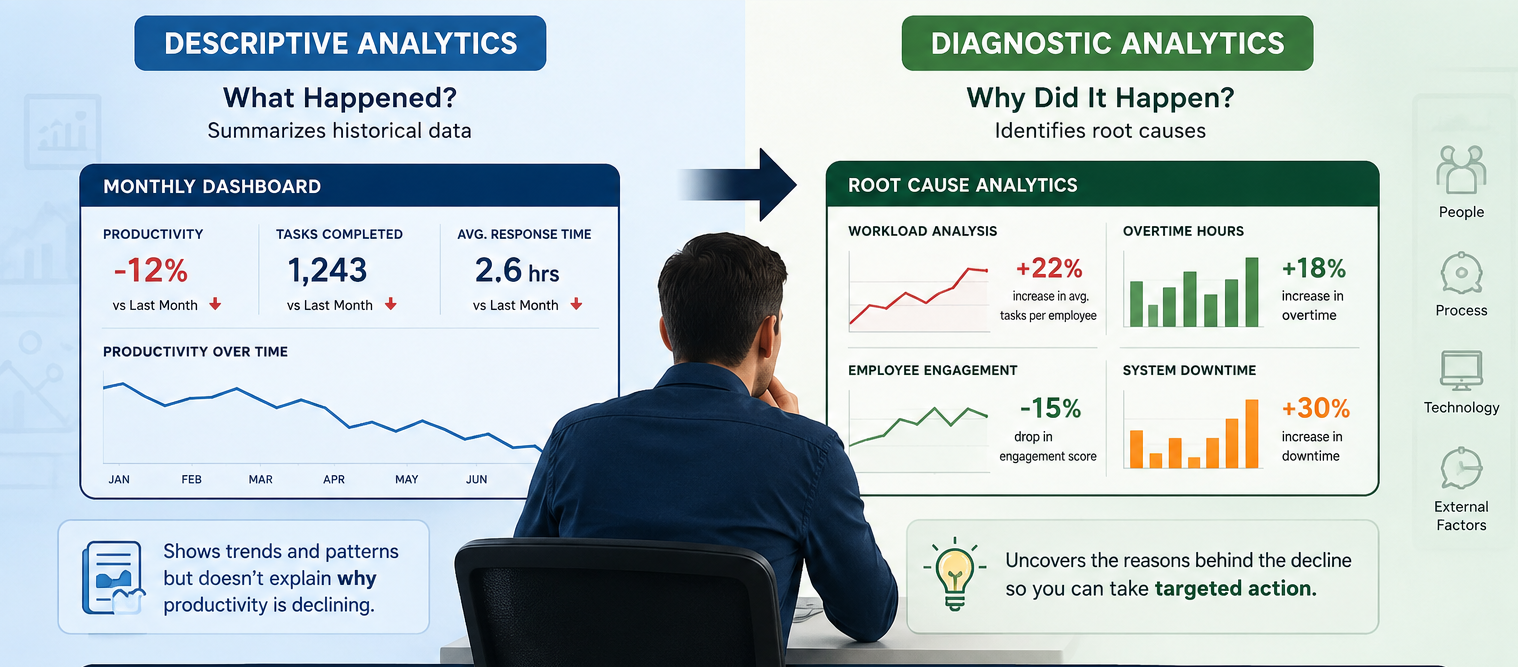
An organization may regularly produce monthly dashboards showing key indicators such as employee output, project completion rates, customer response times, and operational performance metrics. While these dashboards can reveal that productivity is declining, they often fail to explain why the decline is happening. This is where understanding the difference between descriptive and diagnostic analytics becomes essential.
Descriptive analytics focuses on summarizing historical data and presenting what has already happened within an organization. In this scenario, the monthly dashboard serves as a descriptive analytics tool because it reports productivity trends, highlights performance indicators, and shows whether productivity has increased or decreased over time. It provides visibility into business performance but stops at presenting facts and trends. Diagnostic analytics, however, goes beyond reporting events and attempts to determine why those events occurred. Rather than simply showing that productivity has dropped, diagnostic analytics investigates the underlying reasons behind the decline.
Diagnostic analytics uncovers root causes by examining relationships between variables and drilling deeper into available data. For example, an organization experiencing lower productivity may analyze employee attendance records, workload distribution, system performance logs, customer demand patterns, training levels, or staff engagement metrics. Through techniques such as correlation analysis, trend comparisons, drill-down analysis, and segmentation, organizations can identify contributing factors. The investigation may reveal that employees are overloaded with tasks, certain departments are understaffed, software systems are experiencing downtime, or employee morale has decreased. By identifying these underlying causes, management can move from simply observing a problem to implementing targeted solutions.
Although descriptive analytics provides useful information, relying solely on it has several limitations. Descriptive analytics tells organizations what happened but cannot explain why it happened. This limitation restricts effective decision-making because managers may respond based on assumptions rather than evidence. It also lacks predictive capability, meaning it cannot anticipate future outcomes or emerging risks. Additionally, descriptive analytics may create a false sense of understanding where decision-makers believe they have sufficient information simply because they have access to visually appealing dashboards and reports. Without deeper investigation, organizations risk making ineffective decisions and failing to address the actual drivers of business challenges.
Organizations seeking meaningful business insights should therefore move beyond descriptive reporting and embrace diagnostic analytics. Dashboards are valuable tools for monitoring performance, but true organizational improvement begins when data is used not only to observe outcomes but also to understand the reasons behind them.


