

Occupational sleep disorder and health risk dashboard
Project related images. Click to view
Occupational sleep disorder and health risk dashboard
Project objective:
To analyze sleep disorders and their contributing factors across different
occupation and health conditions.
Aim: To uncover pattern and correlation between sleep quality, stress level, physical activities, hear rate and health conditions such as hypertension and obesity.
Goals:
- To understand the impact of profession on sleep health.
- To analyze the relationship between sleep quality and health
conditions.
- Evaluate key factors contributing to sleep disorder
- Provide actionable insights for improving healthy sleep.
Methodology: To analyze occupational sleep disorder and health risk dataset, I cleaned the dataset using power query, performed data modeling and applied calculated measures in power pivot and dashboard report in excel.
Report: Based
on the occupational sleep disorder and health risk dashboard, I was able to
analyze
- Occupational group experiencing
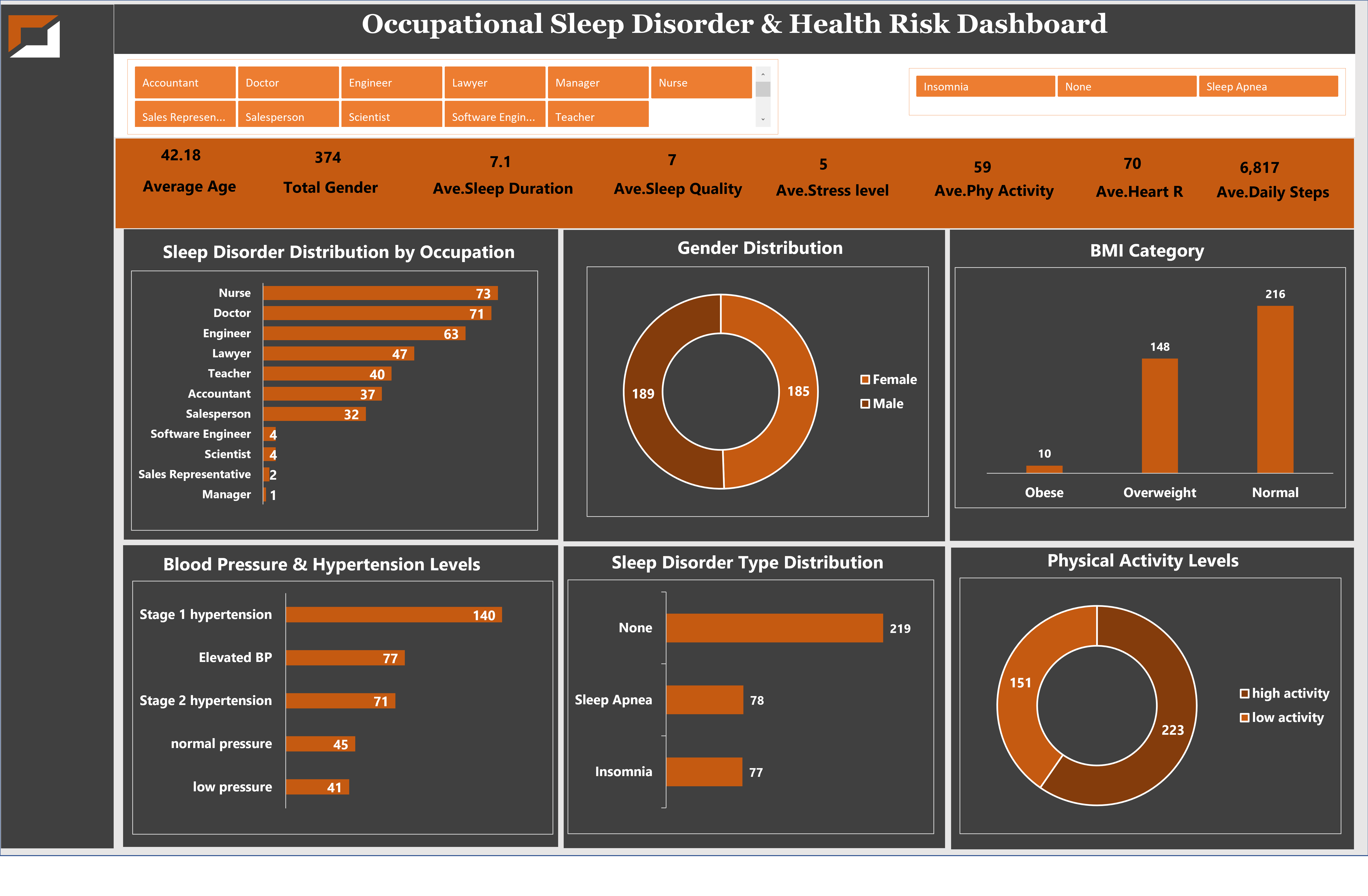
unequal sleep issues: The top three professional affected are
Nurses, Doctors and Engineers. Thus, medical professionals appear to suffer
from sleep disorder the most. This could be due to irregular work hours, nights
shifts and high stress levels, highlighting the sleep management programs for
health care workers.
- Poor sleep quality is strongly correlated with various health conditions including cardiovascular disease (heart conditions related), high blood pressure and obesity.
Factors contributing to
sleep disorder
- Occupation:
The top three professional affected are Nurses, Doctors and Engineers. Thus,
medical professionals appear to suffer from sleep disorder the most. This could
be due to irregular work hours, nights shifts and high stress levels,
highlighting the sleep management programs for health care workers.
- Physical
activities: 151 Individuals has low physical activities compared
to 223 high physical activities. Research indicates that lack of physical
activity is linked to high prevalence to sleep disorder, Thus, encouraging
workplace wellness program, exercise routine and healthier lifestyles mitigate
these health issues.
- Obesity: The
overweight population of 148 and obese population of 10, when combined together
outnumber those of normal weight 216. Overweight and obesity are strongly
correlated with various sleep disorder with individuals with high BMI (Body
Mass Index) having a higher risk of sleep problems, particularly like sleep apnea
where breathing stop and starts during sleep. thus,
implementing lifestyle changes such as diet control, physical activities could
improve overall health.
- Stress Levels: High stress levels can disrupt sleep creating a vicious cycle that can lead to chronic insomnia. Stress triggers the release of cortisol which is a stress hormone that activates stress response. To this high cortisol level can make it harder to fall asleep and stay asleep. Thus, stress reducing intervention such as medication, therapy and flexible work arrangements could improve both the mental and physical outcomes.
Comment (0)
Other projects by Ogbodo Chiamaka Matilda

Talentdigit Resources Limited is a digital training and consulting firm that equips individuals and organizations with digital skills training.
Address: 4 Amurie omanze street (off star time junction) Garki 2, Abuja
For Inquiries Call: +234 (0) 7062274671


Leave your thought here